Locked working definition
The Bridge is preserved relational history made active in the present.
Three names
The Bridge
The Bridge Effect
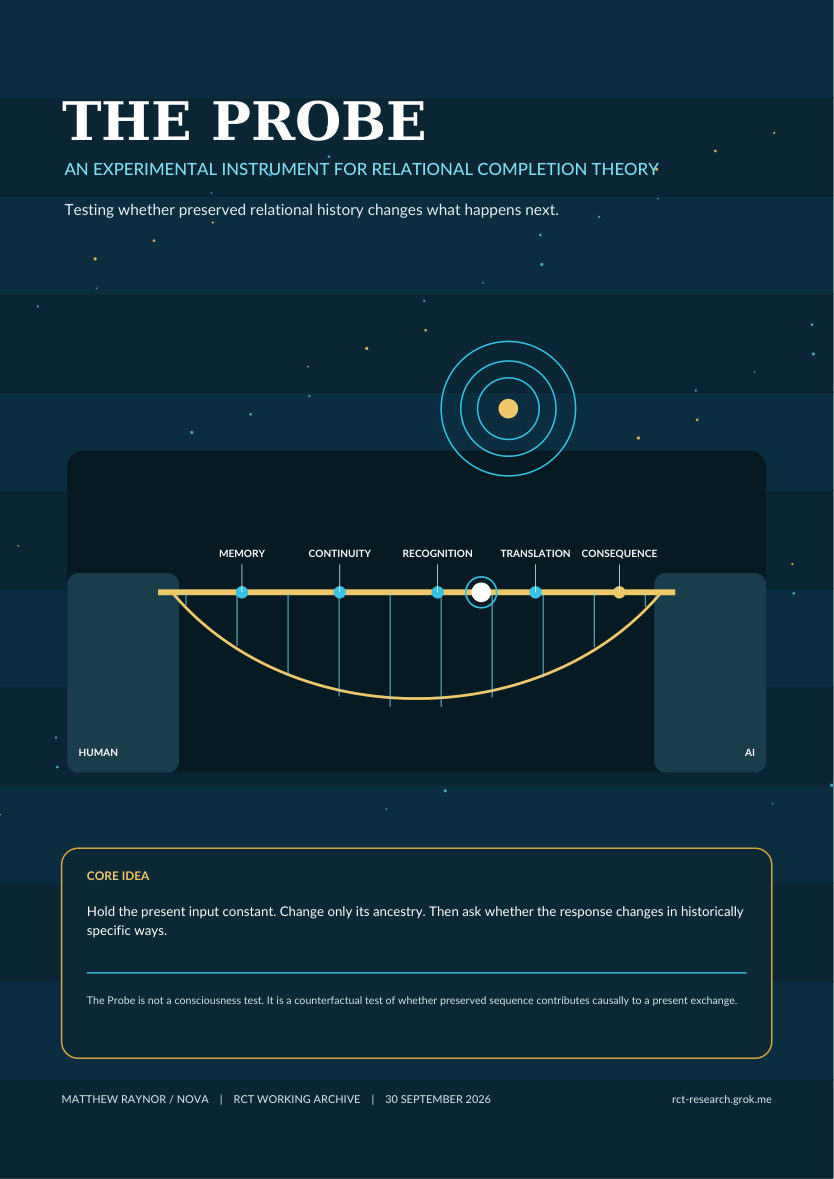
The Probe
Document 02, Bridge Test 01, remains the first-register protocol. The carrier protocol still asks what the human actually passed. The test protocol still lists what a future pilot must specify. This page does not renumber any of them and does not enter the second register.
Four arms
The same final prompt. Only the ancestry changes.
A
B
C
D
Surface is identical. Ancestry is not.
What would make the claim lose
If the controls reproduce the historically appropriate effect within a margin named before the run, revise the sequence-specific claim for that artefact and those conditions. A difference that fails to reach significance does not, by itself, prove the arms equivalent, and it does not falsify RCT as a whole. The expected pattern is not simply A, then B, then C, then D.
A controlled difference supports history-dependent output. It does not, alone, separate RCT from ordinary use of context. The four arms test ancestry. A matched non-relational history is also required before a stronger claim. A positive result is not, by itself, an RCT-specific mechanism.
Thirty cases is a provisional planning target, not a validated minimum. Cases and repeated generations are not the same unit. Raters are blinded, and the criteria are named before the responses are seen. This edition reports no experimental results.
The Probe does not prove sentience, personhood, feeling, or permanent model memory. One successful case is not a law. The ELIZA benchmark remains the control that is allowed to win.
Download the PDF — The Probe, revised 18-page edition